
The Human Impact of Innovation
Angie Kellen, Director, Client Services, Open Sky Communications
My mom is 85 years old. She texts her children, grandchildren, and great-grandchildren on a regular basis. She joins family video calls and uses technology to help manage different aspects of her health. And recently, Mom used artificial intelligence as a creative partner to help bring a decades-old dream to life by creating personalized storybooks for her great-granddaughters. 10 or 15 years ago, some of these experiences would have been almost impossible. Today, they are simply part of how our family stays connected, creates memories, and shares moments across the miles. And that, to me, is the true promise of technology.
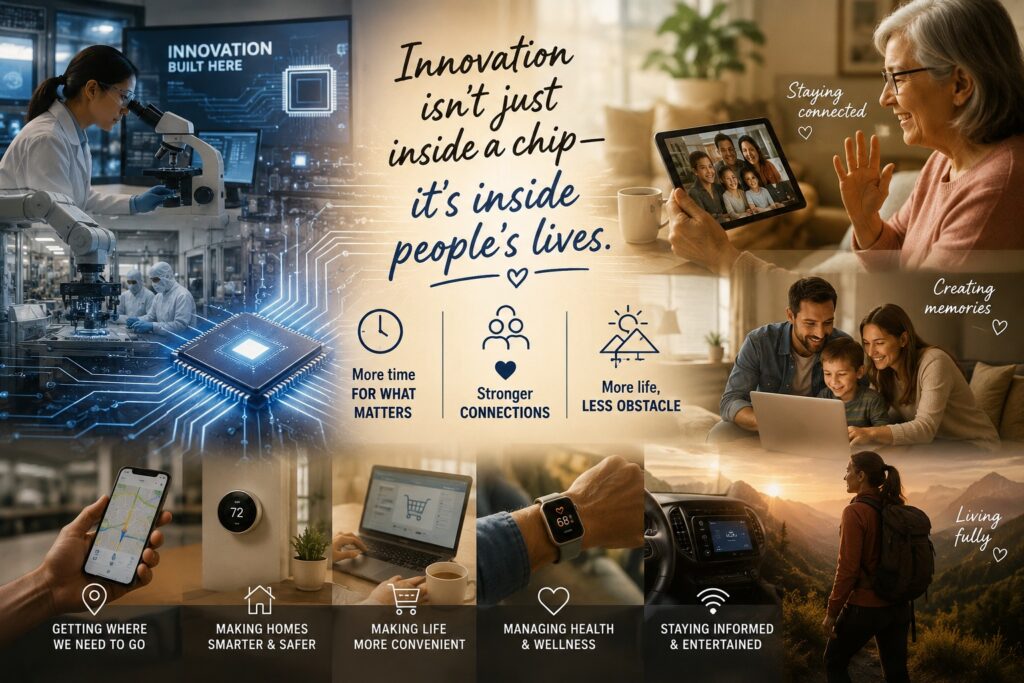
The human impact of innovation. Source: ChatGPT
I have had the privilege of witnessing some of the most amazing technology advances of our time. I’ve sat across from engineers developing next-generation semiconductor technologies and listened to them explain breakthroughs in photonics, AI, and advanced computing. I have helped companies tell the stories behind some of the innovations that are shaping the future of our world. It has been fascinating to see the creativity, dedication, and ingenuity behind these breakthroughs. But over the years, I’ve also realized something important. The most meaningful impact of technology is not always found in the lab or the manufacturing facility; rather, it is found in people’s lives. In this blog, I will look at technology from the lens of a non-technical person and highlight the various ways that it has personally impacted my life.
The headlines often focus on what machines might replace, what jobs could disappear, and whether technology is moving us further away from those experiences that define us. I understand the concerns and believe many of the questions being raised are important ones. Technology should always be developed responsibly and with a clear understanding of its impact on society. But I also know there is another side of the story that often gets overlooked. To me, the true measure of innovation is not what happens inside a chip, it’s what happens in people’s lives because of it.
Most people do not wake up in the morning thinking about processor speeds, semiconductor architectures, AI models, or the latest breakthroughs in computing. They think about everyday life with their families and the people they love. They think about how to spend more time creating memories and less time dealing with the obstacles that keep them from those activities.
And when I look at my own experience, there are many examples of how technology has given me more opportunities to enjoy life. It has helped my family stay connected across thousands of miles and older family members to maintain their independence. It has helped me recover from injuries faster and even helped my mother finally accomplish something she had dreamed about for decades. I believe technology, at its best, does not replace our human connection but can create more opportunities for it.
Technology Is Really About Time
I experienced this concept firsthand when I was in high school and suffered a serious sports injury that required major knee surgery. At the time, arthroscopic surgery was still relatively new, and while my doctors hoped they could repair the damage through a minimally invasive procedure, the extent of the injury required a much more traditional approach.

Me doing some running and jumping. Source: Angie Kellen
The recovery was long, difficult and very frustrating. It required patience, a lot of physical therapy and a significant amount of time away from the activities I loved, which was running and jumping. I had gotten to a point in my recovery where I was just happy to walk without crutches.
Eventually, I did get back to the fun of running and jumping again. Years later, I faced additional surgeries involving my ankle and feet. By then, medical technology had advanced significantly. Surgical techniques had improved, imaging technologies had become more sophisticated, and procedures that once required much more invasive approaches could often be performed with smaller incisions, greater precision, and faster recovery times. My recent surgery and recovery were like night and day compared to my previous experience. It was really amazing and that made me very happy.

Me, post foot surgery. Source: Angie Kellen
As a patient, I was not thinking about the technology behind those improvements even though from my job I was familiar with what they were. I was not thinking about the sensors, imaging systems, processors, or advanced medical equipment that enabled those procedures. My thoughts were all about getting back to my life. I was thinking about walking without pain, returning to my running and jumping and not allowing an injury to define my future. The technology mattered because it gave me time.
The same principle applies to so many innovations we use every day. Better diagnostic tools allow physicians to identify problems earlier. Advanced imaging helps doctors make more informed decisions. Remote monitoring allows patients to manage aspects of their health from home. Digital tools help families coordinate care and stay informed. The value is the life that technology allows us to continue living.
Technology and the Gift of Independence
This became even more meaningful to me as I watched technology become part of my mom’s everyday life.
As I mentioned earlier, she is 85 years old, and like many families today, ours is spread across different states. Children, grandchildren, and great-grandchildren live in different places, and maintaining close relationships across those distances requires effort. But technology has completely changed what that effort looks like. When I was younger, staying connected with family members who lived far away meant planning phone calls when the long-distance rates were lower, waiting for photographs to arrive in the mail, and realizing that some important moments might be experienced through stories shared after the fact.
Fast forward to today and a picture can arrive instantly. And that picture or message can brighten someone’s day in seconds rather than waiting for a week to get the same effect. I love that a video call can bring an entire family together, even when everyone is separated by hundreds or thousands of miles. Technology has changed our ability to overcome distance.
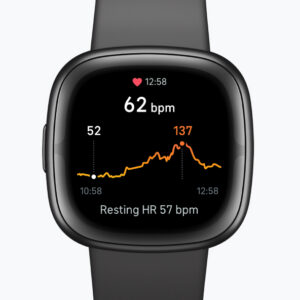
Source: Fit Bit
My mom regularly sends texts to stay connected with her children, grandchildren, and great-grandchildren. She shares updates, receives photos and videos, and participates in conversations that might have been impossible or much more difficult even 10 years ago. She has discovered that she can participate in telehealth appointments when traveling to a doctor’s office is just too challenging. She also uses wearable technology in the form of a fit watch that helps her monitor her daily activity and stay engaged with her vitals. She has even become a bit competitive with the numbers!
For many older adults, technology is not just about convenience, it’s about independence. It’s about continuing to participate, contribute, and engage with the world by staying connected with friends and family. It provides some level of control over your daily life and that is something very valuable as we age. In addition, it provides a new learning experience. Not all seniors are fond of technology, but those that embrace it and actively learn it feel the benefits.
For our family, technology also provides reassurance. Knowing that Mom has devices, that she knows how to use, that are available to her to help stay in contact with us, that manage aspects of her health, and that help her maintain her independence provides a sense of comfort that didn’t exist for previous generations.
The AI Experience That Changed My Perspective
One of my favorite examples of technology enabling a more human experience came through my mom’s desire to write a book. For many decades, she talked about wanting to write a book or a story. It was something she had always wanted to do, but like many dreams, life kept getting in the way. There were responsibilities, and everyday demands of children, and then grandchildren that pushed the idea further into the future. After retiring, she decided she wanted to create something truly special for her two great-granddaughters.
She wanted to write a personalized story for each child, creating an adventure that included their names, their personalities, and illustrations that would bring the story to life. It was going to be based around life in a pond.

Rhye, The Daring. Duck Source: Mary Lou Kellen
It was an ambitious project, especially for someone starting from scratch. Writing a children’s book requires developing characters, building a storyline, organizing the structure, and creating artwork that captures the imagination of a child. This is where AI became a partner rather than a replacement.
Together, we used AI to brainstorm ideas, explore possibilities, and help organize the creative process. Mom reviewed the suggestions, changed what did not feel right, added her own memories and imagination, and shaped the stories into something that reflected her voice. We also experimented with image-generation tools to create images based on the adventures she envisioned in her stories. The process was not perfect and there were lots of laughs at what we created through trial and error.

Avila, The Performer. Source: Mary Lou Kellen
There were moments when AI came up with ideas that were creative but not exactly what we had in mind. Some images were funny, some were surprising, and some did not make the final version. But through this process, something amazing happened. The technology removed many of the barriers that could have kept her from ever completing the project. Instead of getting stuck trying to figure out formatting, images or how to begin, she was able to focus on the part that mattered most, which was telling the story.
The technology actually amplified her creativity. It wasn’t this technology that wrote the books, she did. AI simply gave her the tools to bring an idea that had lived in her heart for decades into reality. Today, those books sit proudly on her great-granddaughters’ bookshelves. And they are examples of human creativity, love, and imagination supported by technology.
Technology Creates More of Life’s Best Moments
I see friends and families staying connected in ways that previous generations could never have imagined. One of the most meaningful examples for my family came when my nephew, Jimmy, had his Air Force commissioning ceremony in Colorado. Because of distance, schedules, and the realities of life, not everyone could be there physically. But technology allowed us to participate. Through video conferencing, our family was able to share the experience together.

Grandpa Ron and Jimmy Kellen. Source: Angie Kellen
During the ceremony, my father, who also served in the Air Force, was honored by receiving Jimmy’s first salute. My father wore his old Air Force uniform, which, remarkably, still fit him! For our family, that created its own moment of admiration and amazement. But beyond that, it was a deeply emotional family experience. There he was, standing proudly in uniform, receiving a salute from his grandson, while family members who were hundreds of miles away were still able to witness and share that moment. We were not simply watching, we were participating. Technology created a bridge between where we physically were and where we wanted to be.
The Goal Was Always Better Lives
Technology will continue to evolve and become more capable and accessible. Medical innovations will continue to improve and the devices we rely on every day will become even more integrated into our lives. But I hope we never lose sight of why we pursue innovation in the first place. The goal was never simply to build faster chips or more sophisticated machines. The goal has always been to improve our lives and the human experience.
For me, technology is measured by the smile on my mom’s face as she reads a story she finally got around to creating for her great-granddaughters, by the comfort of knowing she can remain independent a little longer, by recovering from surgery more quickly so I could get back to the running and jumping that I love, and by being able to witness my nephew’s Air Force commissioning ceremony alongside my family, even from hundreds of miles away. Those are the moments that really matter.
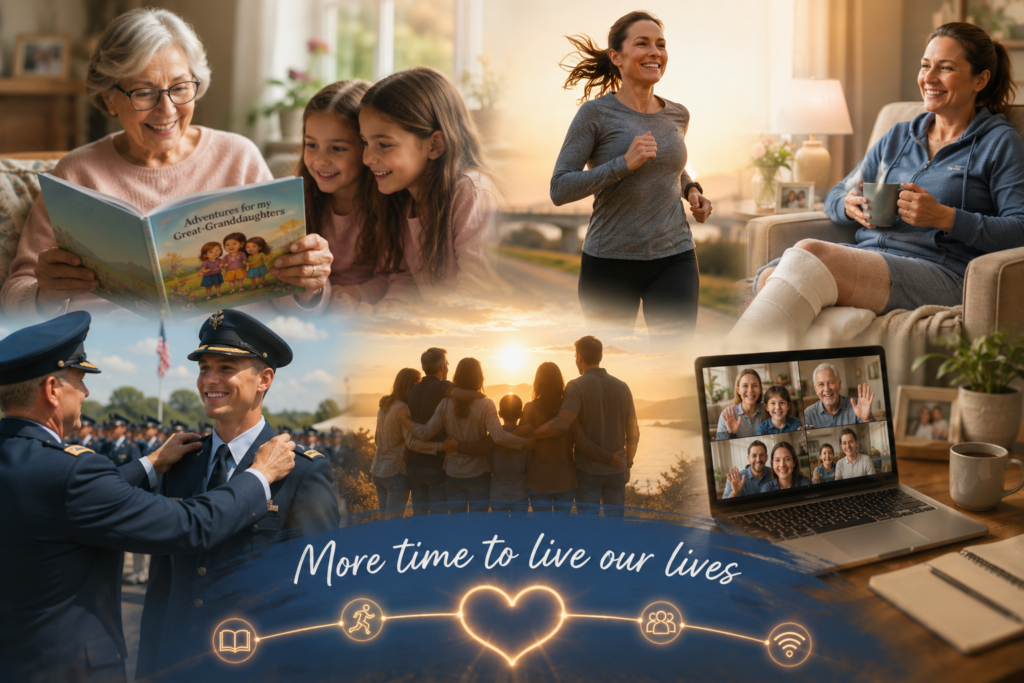
This is how technology imaged this blog! Source: ChatGPT
People rarely remember the technology itself. They remember the memories it helped create, the obstacles it removed, and the people it brought closer together. And if technology can help us spend less time focused on limitations and more time focused on living, loving, creating and connecting, then perhaps it is doing exactly what it was intended to do all along, giving us more opportunities to be human.