
Beyond AI: Why Quantum Computing’s Future May Depend on Silicon Photonics
Angie Kellen, Director, Client Services, Open Sky Communications
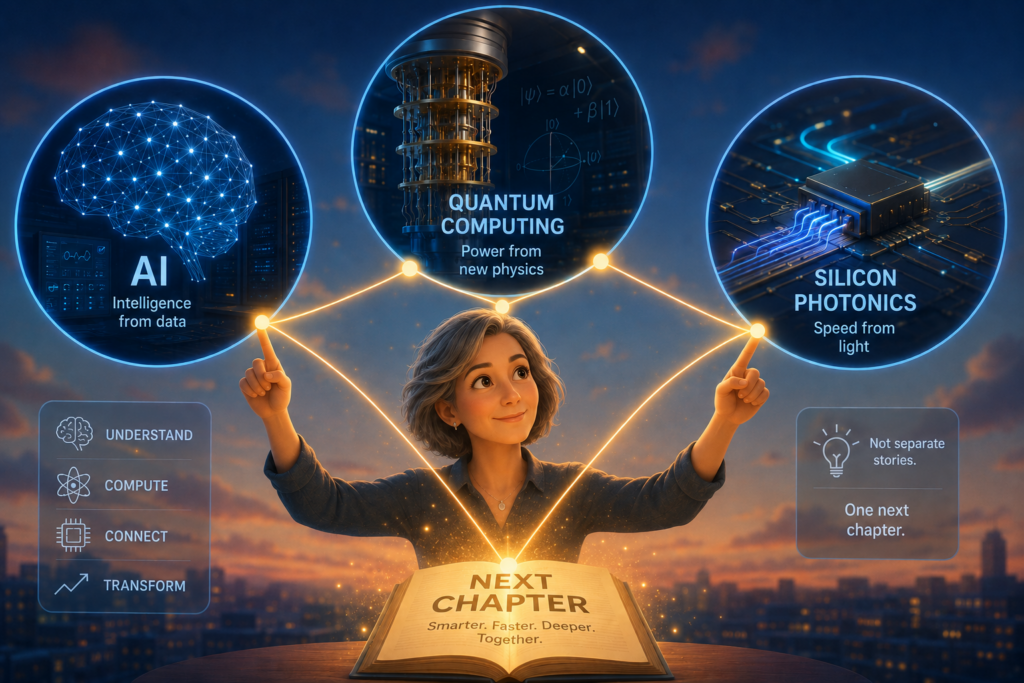
Source: Open AI ChatGPT
For the past several years, AI has dominated nearly every technology conversation. It is so prevalent that I do not even feel the need to spell out the two-letter acronym anymore, but just in case you have been tucked away and shielded from the news for the last decade, going forward, I will refer to artificial intelligence simply as AI. AI infrastructure spending has exploded, individuals and companies are racing at a fever pitch to determine how to implement this technology into every conceivable application, and suddenly every company pitch slide deck has an “AI strategy,” whether it needs one or not.
AI is here, and it continues to evolve, hopefully with enough guardrails to keep humanity from accidentally creating an army of sarcastic robot overlords. But while AI has been grabbing headlines, another technology wave has been quietly, and increasingly not so quietly, building momentum behind the scenes. That technology is quantum computing.
Having spent more than two decades around the semiconductor industry, I have learned that technology revolutions rarely show up with a big neon sign announcing that they are about to change the world. They usually begin as research projects tucked away in university labs or government-funded programs. Then comes a period where everyone debates whether the technology will ever be practical. I have sat through enough conference presentations over the years to know that half the room thinks it is the future and the other half thinks it is still a science experiment. Then the investments start pouring in, engineering problems begin to get solved, and suddenly what seemed impossible becomes the next industry tech race.
I watched the internet evolve from a novelty into the backbone of modern business. I watched cloud computing move from “someone else’s server” to the foundation of nearly every digital service we use today. More recently, I have watched AI transform from an interesting academic exercise into the centerpiece of nearly every corporate strategy meeting. That’s why quantum computing feels curiously familiar.
The funny thing is that quantum computing is not really competing with AI at all. In many respects, the two technologies complement one another. AI demands enormous computational resources, while quantum computing offers an entirely different way to approach certain classes of highly complex problems. If anything, AI may end up helping quantum get off the ground. Helping to bridge these two worlds is another technology that receives far less attention outside of semiconductor circles but may prove just as important. That technology is silicon photonics. So rather than treat these as separate stories, I want to connect the dots between AI, quantum computing, and silicon photonics, because I believe they are all part of the same ‘next chapter.’
What Exactly Is Quantum Computing?
This is not an easy answer, but at its simplest level, traditional computing is built on bits that exist as either a zero or a one. Every email, spreadsheet, social media post, and AI-generated image ultimately boils down to billions upon billions of these binary decisions being processed at astonishing speeds.
Quantum computing tosses that structure out of the window. Instead of bits, quantum computers use quantum bits, or qubits. Thanks to the principles of quantum mechanics, qubits can exist as zero, one, or a combination of both states simultaneously through a property known as superposition. They can also become interconnected through a phenomenon called entanglement, allowing changes in one qubit to correlate with another in ways that simply do not exist in classical systems.
Think of Schrödinger’s famous cat experiment. Until you look inside the box, the cat is theoretically both alive and dead at the same time. It sounds absurd, but it illustrates the strange rules that govern quantum mechanics. That all sounds almost mystical, which is probably why quantum computing sometimes gets treated like magic. It also explains why perfectly intelligent people tend to nod politely during explanations and then immediately go search for a YouTube video afterward. I’ll save you the trouble, here is a YouTube video on this concept. In reality, it is simply physics behaving exactly as physics says it should, just at scales that our everyday experiences do not prepare us for. Fortunately, quantum engineers understand the physics far better than most of us will ever need to.
The analogy that finally made it click for me was this: imagine trying to find the fastest route through every city in the United States. A classical computer might evaluate one possible route after another, incredibly quickly but still sequentially. An advanced quantum computer could evaluate many possible solutions at the same time, dramatically reducing the time required to arrive at an answer. Google’s Willow Quantum Computer. Source: Google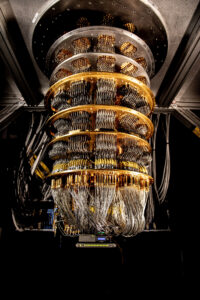
Companies like IBM and Google continue to push the technology forward, while startups including PsiQuantum, IonQ, and Quantinuum are pursuing different approaches to making quantum systems commercially viable.
According to McKinsey & Company, quantum computing could create up to $1.3 trillion in economic value by 2035 across industries including pharmaceuticals, chemicals, finance, and logistics.
The challenge is that qubits are incredibly fragile. They can lose their quantum state through even minor interactions with the surrounding environment. Maintaining stability requires sophisticated error correction, extreme precision, and in many architectures, temperatures colder than outer space. And this is where silicon photonics starts to become part of the story.
Silicon Photonics: Moving Data at the Speed of Light
If quantum computing sounds like science fiction, silicon photonics sounds like one of those terms engineers use just to make everyone else uncomfortable. In reality, the concept is fairly uncomplicated. Traditional computer chips move information using electrical signals traveling across microscopic interconnects. Silicon photonics replaces many of those electrical pathways with light. Instead of electrons carrying information, photons do the work.
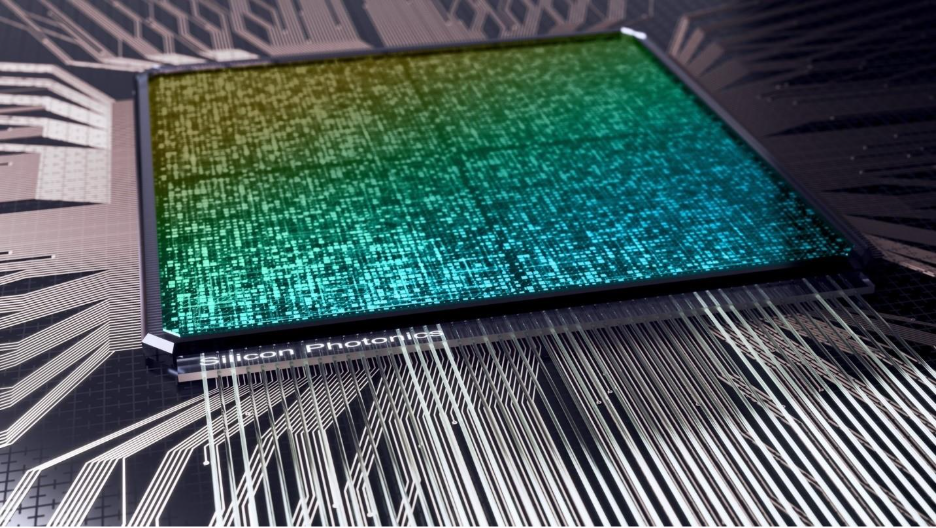
Silicon Photonics. Source: Lam Research
This matters because photons move extremely fast, generate far less heat, and can transport enormous amounts of information simultaneously. As AI infrastructures continue to expand, moving data around efficiently has become almost as important as processing it.
The semiconductor industry is running into practical limitations. More computing power means more energy consumption, greater heat generation, and increasingly expensive cooling systems. According to the International Energy Agency, electricity demand from data centers is expected to rise significantly as AI infrastructure expands. Silicon photonics offers a compelling solution by reducing the energy required to move massive amounts of information.
From my perspective, one of the most attractive aspects of silicon photonics is not simply the physics. It is the manufacturing. One lesson I have learned over the last twenty years in semiconductors is that breakthroughs rarely succeed on innovation alone. They succeed because they can be manufactured repeatedly, economically, and at scale. The transistor changed the world because fabs learned to build billions of them with astonishing consistency. Silicon photonics has the potential to follow that same path.
Anyone who has spent time around semiconductor manufacturing knows that elegant physics is only half the battle. The real magic happens when you can build the same thing over and over again with incredible precision and still make money doing it.
Rather than inventing an entirely new fabrication ecosystem, many photonic devices can leverage modified CMOS manufacturing processes that already exist inside advanced semiconductor fabs. That compatibility has attracted major investments from companies including Intel, Broadcom, NVIDIA, and Cisco.
Why Silicon Photonics Could Unlock Quantum Computing
The biggest obstacle facing quantum computing is not proving that it works. Researchers have already done that. The challenge is scale. Building a machine with a few hundred qubits is impressive. Building one with millions of stable, interconnected qubits capable of solving commercially valuable problems is something else entirely. For years, quantum computing felt like one of those technologies that was always five or ten years away. Lately, though, that timeline seems to be shrinking.
Many current quantum systems require highly specialized laboratory environments with extensive wiring, cooling infrastructure, and complex control electronics. As qubit counts increase, so does the engineering challenge. Silicon photonics offers a fundamentally different approach.
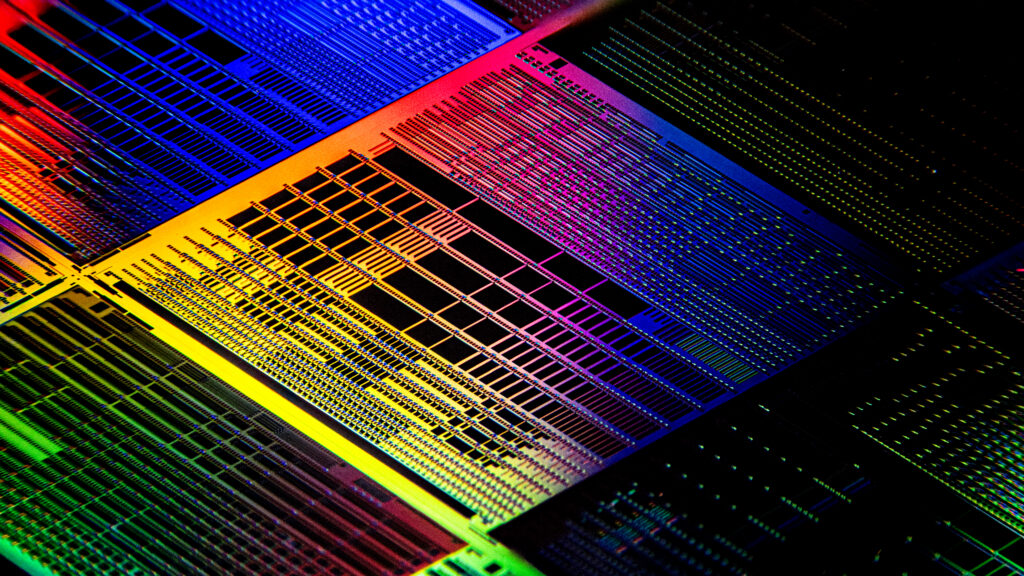
Quantum Photonic Chip from PsiQuantum. Source: PsiQuantum
In photonic quantum computing architectures, particles of light become the information carriers. Because photons interact very weakly with their environment, they are naturally resistant to certain forms of noise that can disrupt quantum states. Companies like PsiQuantum have built their entire business strategy around this concept, leveraging existing semiconductor foundries to manufacture photonic quantum chips. At the same time, Xanadu is advancing integrated photonic quantum systems that combine optical circuits with quantum computing architectures.
Researchers believe integrated photonics is one of the most promising paths toward scalable quantum computing because it enables generation, manipulation, and detection of quantum states on compact chips.
After years of watching semiconductor manufacturing evolve, I cannot help but see the parallels. As I mentioned earlier, the industry did not transform the world because it built one remarkable transistor. It transformed the world because it learned how to manufacture billions of them reliably and economically. Quantum computing may ultimately require this same kind of industrial scaling.
Follow the Money
Another lesson that I’ve learned is that if you really want to know whether a technology is becoming real, stop reading the headlines and follow the money. Venture capitalists, governments, and large technology companies are not always right, but they rarely spend billions of dollars on science projects they expect to disappear.
Governments and private industry have collectively invested tens of billions of dollars into quantum technologies. The United States, China, the European Union, and the United Kingdom all view quantum leadership as both an economic opportunity and a national security priority. In an article by Mark LaPedus of Semiecosystem, the U.S. plans to invest $2B in quantum computing firms & foundries. Read his article for more details here. Private investors are equally enthusiastic. Companies including PsiQuantum, IonQ, Quantinuum, Rigetti, and D-Wave have attracted substantial funding as investors search for the company that could ultimately become the NVIDIA of quantum computing.
Silicon photonics is benefiting from the AI boom, driven by increasing demand for high-speed optical communications in AI and cloud infrastructure. Interestingly, silicon photonics does not have to wait for quantum computing to become mainstream. AI is already creating enormous demand for optical networking technologies today. In a way, AI may end up funding part of the infrastructure that eventually enables practical quantum computing.
Quantum Computing and Silicon Photonics Are Already Working Together
When most people hear “quantum computing,” they picture a futuristic machine hidden away inside a government laboratory. The reality is a bit less dramatic. Quantum computers are already being used experimentally to tackle highly specialized problems. Pharmaceutical companies are exploring molecular modeling to accelerate drug discovery. Financial institutions are evaluating optimization algorithms for portfolio management and risk analysis. Logistics companies see opportunities to improve routing and supply chain operations.

IBM Quantum Lab, Yorktown Heights, NY. Source: IBM
IBM has built a cloud-accessible quantum platform that allows researchers and developers around the world to experiment with quantum algorithms. Google has advanced the field by pushing the boundaries of quantum hardware and software through its Sycamore processors and Google Quantum AI initiative, while making its quantum resources available to researchers through the Google Cloud ecosystem. Amazon Web Services offers Amazon Braket, a managed quantum computing service. At the same time, Microsoft continues to expand Azure Quantum, creating an ecosystem for developing future quantum applications.
Silicon photonics plays an important role in many of these efforts, particularly where optical communication and photonic qubit architectures are involved. Integrated photonic circuits can generate, route, and measure photons with extraordinary precision, making them attractive building blocks for scalable quantum systems.
Companies like PsiQuantum are taking this concept even further by designing entire quantum computing architectures around photonic technologies manufactured in advanced semiconductor foundries.
That approach may prove to be one of the most important developments in the industry. Instead of reinventing manufacturing from scratch, photonic quantum computing can potentially leverage decades of investment and expertise from the semiconductor ecosystem. That is a powerful advantage.
Looking further ahead, the possibilities become even more compelling. Quantum computing could accelerate the discovery of new materials, improve battery technology, optimize global transportation networks, and dramatically reduce the time required to develop new medicines.
One of quantum computing’s greatest strengths is also one of its greatest concerns. Large-scale fault-tolerant quantum systems could eventually break many of today’s encryption standards. That is why the U.S. National Institute of Standards and Technology (NIST) continues to lead efforts to standardize quantum-resistant encryption algorithms.
The Next Technologies
If I have learned anything, it is that technology revolutions rarely happen in isolation. They stack on top of one another. The internet enabled cloud computing. Cloud computing accelerated AI. AI is now driving unprecedented investment in advanced semiconductor manufacturing, optical networking, and silicon photonics.
Those same investments may help unlock scalable quantum computing. Ironically, AI may become one of quantum computing’s biggest enablers. The infrastructure being built today to support massive AI workloads is forcing innovation in optical communications and photonic technologies. Those advances could ultimately become the foundation upon which practical quantum systems are built.
For now, AI will continue to dominate the conversation, and deservedly so. It is already changing how we work, communicate, create content, and run businesses. But history suggests that while the world is focused on today’s breakthrough, tomorrow’s breakthrough is often quietly taking shape in the background.
After watching this industry evolve for more than two decades, quantum computing feels very much like one of those moments. And if it succeeds, there is a very good chance that silicon photonics will be one of the reasons why. If silicon built the digital age, light may very well build the next one.

Source: Open AI ChatGPT
And somewhere inside a university lab, a startup, or a semiconductor fab, a group of engineers is working on exactly that while the rest of us are still debating whether AI wrote the email we just received.